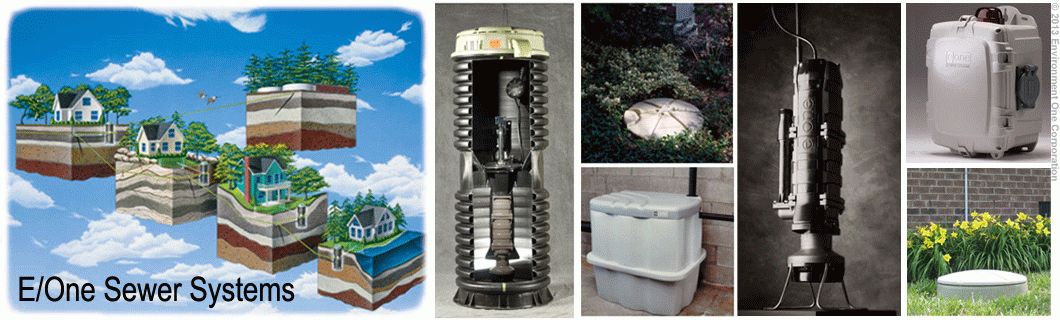
E/One grinder pump stations come with alarm panels that will alert you if something goes wrong with the pump. Depending on when your E/One grinder pump was installed, the alarm panel could be a black box with a red light on top; a gray box with a red light on top; the custom-designed E/One Sentry enclosure, with the E/One logo on the front and red light on top; or even a small switch plate inside your home (usually in the kitchen or hallway) with a red light.
What does the alarm mean? Let's look at two different scenarios:
The alarm turns on for a few minutes, then turns off. We refer to this as a "nuisance alarm." If this happens, consider what was happening when the alarm turned on. Do you have a large spa tub or another appliance that uses a lot of water? Emptying a spa tub can send a large inrush of water into the grinder pump station. If the water level in the tank was close to the "on" level, then the large volume of water came from the tub, the pump may not have turned on quickly enough and the pump was overwhelmed temporarily. This type of alarm should turn off after 15 minutes or so.
The alarm turns on for a few minutes, then turns off, but it happens often. Repeated nuisance alarms may be more than a nuisance; they may indicate the early stages of your pump needing service. When the pump is working properly, you shouldn't notice much sound from the pump and not from the alarm panel. But if you're using a typical or reasonable amount water in the house and you get repeated alarms, you may want to call for service.
The alarm turns on and stays on. Service is required because the pump has stopped working. Never, never, never silence the alarm and leave it be. Don't turn off the breakers in hopes of clearing the alarm. Stop using water (or use as little as possible) and call for service. If you continue to use water, you will cause a backup into your home or yard.
Finding a Service Provider
E/One recommends contacting an authorized service center for repair. Using a non-E/One plumber or other pump repair may not be covered by the warranty.
First, start with your town or HOA. Some localities have their own service people or contracts with local repair businesses. If you're responsible for your own service, contact your local E/One distributor or call our Service Link at 1-866-539-9803 (in the US). Some of our distributors have their own service departments, or they can recommend a service provider.
More Information
Visit our web site for more information about grinder pump service. Download and print our Owners Guide for reference; there is space on the back to fill out your local service provider's contact information. If you'd like a copy mailed to you, contact us at eone@eone.com.
All about grinder pumps & pressure sewer systems
Tuesday, March 24, 2015


Thursday, October 30, 2014
New Product: iota OneBox Operates & Monitors Grinder Pumps Remotely
The iota OneBox telemetry system from E/One Sewer Systems gives you
complete command of your fleet of pressure sewer grinder pumps from your office
desktop or a smartphone. Now you can improve customer service and take
corrective actions as they arrive, while dramatically improving your response
time and system efficiency overall.
 | ||
| iota OneBox, available from E/One |
Integrate
OneBox into your SCADA network
seamlessly and get the information you want about tank storage capacities,
power failures, blockages, and faults … instantly! Get diagnostics for
individual properties, streets or whole networks in real-time — cost
effectively.
OneBox delivers:
- Remote control and monitoring of individual grinder pumps
- Alerts even before the customer becomes aware of any faults
- Trend analysis, report generation, peak flow demand determinations
- Flow smoothing and maximized efficiency of downstream infrastructure
Developed
for utilities by South East Water Corporation, one of Australia’s leading water
utilities, the iota OneBox is
now available in the United States exclusively through E/One Sewer Systems.
Friday, October 24, 2014
Case Study: Grinder Pumps Fuel Economic Growth
Southside sits in a rural area of Arkansas. Residents relied on septic tanks, which had a number of problems: some were a half-century old and ending their useful life, but more so, the shallow, soggy soil didn't perc well ... vital for septic systems.
"Improving the wastewater system represents the absolute top priority," was the urgent message of the 2009 Batesville Comprehensive Plan.
"Existing subdivisions couldn't grow anymore and were becoming unsafe due to raw sewage because of bad percolation," says Richardson. A new collection system was fundamental, he adds, "for growth both residential and commercial."
A gravity sewer system would have cause massive disruption and deep trenches. Crist Engineers, located in Little Rock, had designed pressure sewer systems before and chose E/One grinder pumps to do the job.
What were the results? Read the entire story on E/One's web site.
 |
| Credit: Crist Engineers |
"Improving the wastewater system represents the absolute top priority," was the urgent message of the 2009 Batesville Comprehensive Plan.
"Existing subdivisions couldn't grow anymore and were becoming unsafe due to raw sewage because of bad percolation," says Richardson. A new collection system was fundamental, he adds, "for growth both residential and commercial."
 |
| Credit: Crist Engineers |
A gravity sewer system would have cause massive disruption and deep trenches. Crist Engineers, located in Little Rock, had designed pressure sewer systems before and chose E/One grinder pumps to do the job.
What were the results? Read the entire story on E/One's web site.
Wednesday, October 22, 2014
Case Study: Town of Jerusalem, New York
The Town of Jerusalem is located
in the Finger Lakes region of upstate New York. The region's geography is
gashed by several gullies and deep ravines that run down to Keuka Lake; valleys
and rolling hills used primarily as farm land; and, steep slopes on the
waterfront.
It was precisely the natural
beauty and rocky terrain the region prizes that would make it laborious, environmentally disruptive and almost
certainly cost-prohibitive to excavate
for conventional gravity sewering.
Hundreds of vacation homes (seasonal occupancy is only approximately 20-percent full-time residents) are located very close to the lake, often on small building lots with very little room for septic leach fields. A high water table and ineffective subsurface drainage means the drain fields have poor percolation to begin with, so decline is rapid and inevitable.
The town had required homes to be scrutinized every five years. If an existing septic system flunked
inspection, corrections were required which often included the installation of
a new tank and drain field at a cost of $20,000 to $30,000 per residence. In many instances there was not enough room to put in an up-to-date
replacement.
Constructing a gravity sewer system, back in 1999, was estimated to cost $6 million, whereas an E/One pressure sewer system would cost $3.2 million. The proposed LPS for the Town of Jerusalem eliminated the need for 12 lift stations with a total cost savings of $900,000. Nor did it require a rock excavation outlay pegged at $775,000.
Wednesday, October 1, 2014
E/One Welcomes US Department of Commerce Deputy Under Secretary Hyatt @ WEFTEC
 Deputy Under Secretary for the US Department of Commerce's International
Trade Administration, Kenneth E. Hyatt met with E/One President Eric LaCoppola
and Philip Thompson iota Group Manager for Australia's South East WaterCorporation at WEFTEC in New Orleans this week.
Deputy Under Secretary for the US Department of Commerce's International
Trade Administration, Kenneth E. Hyatt met with E/One President Eric LaCoppola
and Philip Thompson iota Group Manager for Australia's South East WaterCorporation at WEFTEC in New Orleans this week.
Their discussion included the latest developments in E/One's contract with the Melbourne-based utility to
provide over 16,000 grinder pumps to their Peninsula ECO project for what will
soon become the world's largest pressure sewer system.

Tuesday, September 30, 2014
E/One Named "Top Projects Award" Winner by Water & Wastes Digest
News Release:
###
NISKAYUNA, N.Y., Sept. 26, 2014 -- Environment One Corporation (E/One), a pioneer and world leader of low-pressure,
gravity-independent, contour-following sewage collection systems, has been
selected as one of the winners of Water & Wastes Digest's Top Projects Award Program. The presentation will be
made on Tuesday, September 30, in New Orleans on the occasion of the Water Environment Federation’s Annual Technical Exhibition and Conference (WEFTEC®),
the largest event of its kind in North America.
In attempting to clear up an E. coli problem
in the area’s lakes by replacing deteriorating septic systems, E/One and its
client, the Twin Lakes Regional Sewer District in Monticello, IN, constructed
the single largest
grinder pump driven low-pressure sewer project in the Western Hemisphere.
"For this area, for this district, the best thing was
low-pressure sewer," says Mike Darter, general manager of the Twin Lakes
Regional Sewer District. "By far and away
LPS was the only way to sewer this area.
It provided a timely installation with minimal disturbance to the
property owners."
At present, the $65 million project counts
5,071 E/One grinder pumps which service approximately 8,000 residences and
businesses around Lake Shaffer and Lake Freeman. Nearly 300 miles of pressure sewer lines link
across more than 29 square miles and traverse the Tippecanoe River multiple
times. The expected flow from the entire system is 1,285,000 gallons per day
delivered to four separate wastewater treatment plants.
"It's quite an honor for E/One Sewer® systems, and for the grinder pump category which we pioneered
and which was not too long ago considered an 'alternate' technology. Today LPS has become the 'appropriate'
technology solution for a growing number of progressive communities
worldwide," says E/One President Eric LaCoppola.
E/One conceived the concept of the household grinder pump in
the late 1960’s. E/One Sewer systems
have since proven to be an economical and effective method of sewering
otherwise difficult land areas, such as flat, wet, rocky and hilly terrain.
At the heart of an E/One Sewer is the grinder pump,
developed by Environment One. These units accept household sanitary waste,
grind it into a fine slurry, and pressurize it to permit transport through
small-diameter pipes. E/One Sewer systems now serve over one million
end-users daily.
Other participants in the Twin Lakes project include E/One’s
local distributor Covalen; Gorman-Rupp; Reynolds, Inc. (now Layne Heavy Civil),
Orleans, IN; HRP Construction, South Bend, IN; Rothenberger Construction,
Concord, MI; Clyde E. Williams & Associates, LaGrange, IN; RheinBach
Engineers, South Bend, IN; and, GRW Engineers, Indianapolis, IN.
ABOUT E/ONE
Environment One Corporation (E/One) is a diversified,
high-technology company located in Niskayuna, New York, U.S.A. Manufacturing,
engineering, administration and marketing operations are managed from
Niskayuna. Environment One also maintains regional sales offices in key cities
in the U.S.A. and globally. Environment One Corporation is owned by Precision
Castparts Corp. (PCC), a worldwide manufacturer of complex metal components and
products, listed on the New York Stock Exchange under the symbol
"PCP."
Subscribe to:
Posts (Atom)